Spring Rhythms: Compost, Ducks, and New Beginnings
- shaynewh91
- Apr 29
- 7 min read

This time of year always marks a full turning of the compost — one of those seasonal rituals that reminds me how everything here works in cycles. It’s physical, a little messy, and deeply satisfying work. The kind that asks you to slow down, pay attention, and participate in the process rather than rush through it.
There’s something about the smell of earth waking up again, the steam rising from a freshly turned pile in the cool morning air, that signals the shift into spring more than any date on the calendar ever could.
Our system is simple, but deeply layered. It starts in the Duck Yard, where food scraps and plant debris are tossed and then covered with bedding from the Duck Hut — soft wood shavings that balance and build. Every peel, stem, wilted leaf, and leftover bit becomes part of something larger. Over time, it all accumulates into a rich, active layer of life and decay.
The ducks, of course, are at the center of it all. They turn, mix, break things down, and add their own contributions. They are constant collaborators in this system — curious, efficient, and always enthusiastic about the work.
When the duck yard gets too full, we clear it out and move everything to the left-side bin.
The Heat of Transformation

That second pile is the “working” heap — the place where everything really begins to transform. It’s constantly being added to: tree trimmings, garden debris, and whatever else the season offers up. It’s rougher, less refined, and full of texture.
Next to it sits a pile of rotting wood that has slowly been breaking down over time. The ducks love this area. They dig through it, searching for insects and hidden bits of life, turning over pieces of bark with surprising determination.
On cold, wet days, this corner of the yard becomes their refuge. The heat generated from these two piles — the active compost and the decomposing wood — creates a natural warmth that they instinctively seek out. They’ll stand there, tucked into themselves, steam rising faintly around them, drying off before heading back out into the rain.
It’s a small thing, but it feels like a perfect example of how systems can support themselves when given the chance.
Where the Good Stuff Happens

The third stage is quieter. The right-side bin is the resting heap — the one that asks for patience.
Here, the compost is left mostly undisturbed so that worms, insects, and microorganisms can do their work. This is where the transformation slows down and deepens. What was once recognizable — leaves, stems, scraps — becomes something entirely different: dark, crumbly, alive.
The ducks still participate, gently sifting through the top layer, but this space is less about activity and more about balance.
Every so often, I’ll turn it — just enough to keep it from overheating and to make sure the microorganisms are evenly distributed. It’s less about managing and more about listening. Watching the texture, the moisture, the smell.
This is where the good stuff is. The compost that feeds everything else.
Letting the System Work

This year feels like a turning point. For the first time, the garden is truly working for itself — or at least, it feels like we’re finally working with it instead of against it.
Last season, we transformed our yard into a food forest. We removed the lawn entirely, which felt both daunting and freeing. In its place, we planted perennial vegetables and fruits — things that would come back year after year — while still leaving space for short-season crops and experimentation.
It wasn’t about perfection. It was about building something layered, something resilient.
When fall came, instead of clearing everything out in the traditional sense, we let the ducks take over.
All winter long, they worked the land. They ate the dying vegetation, scratched and rooted through the soil for bugs and slugs, and fertilized the entire space as they moved. What might have been a chore became a natural process.
By the time spring arrived, the soil had already been turned, enriched, and prepared.
To begin planting, all I had to do was fence off the areas where seeds and starts would go — protecting them just long enough to establish.
For direct sowing, I used a simple garden cultivator — a hook-shaped hoe — to lightly score the surface of the soil. Seeds were scattered, then covered with our homemade compost.
No tilling.No hauling in amendments.No battling weeds before they even begin.No pest control routines.
Just a system that had been quietly working all winter.
It feels almost like stepping back into an older way of doing things — one that relies more on observation and trust than constant intervention.
A Practice in Paying Attention

Of course, even the most balanced systems require awareness.
One of the ongoing challenges in our yard is bindweed — commonly called morning glory. Despite its delicate white flowers, it’s incredibly persistent and aggressive. It spreads through deep rhizomes that can reach astonishing depths, and even a small fragment can regrow into a full plant.
Above ground, it climbs quickly, wrapping itself around anything it can find. Below ground, it weaves an almost invisible network that is difficult to fully remove.
The ducks help by eating the buds before they can flower and go to seed, which keeps it somewhat in check. But it’s still a constant presence.
While turning the compost this year, I noticed bindweed rhizomes beginning to grow within the pile. It was a small moment, but an important one — a reminder that composting doesn’t magically erase everything. Some things persist. Some things require extra attention.
So now, when I move compost into the garden, I take a little more time. I look closely. I stay aware.
It’s less about eliminating every challenge and more about staying in relationship with the land.
Small Moments That Stay With You

While we were in the middle of all this — turning piles, watching for rhizomes, working alongside the ducks — a group of middle schoolers walked down the street.
Just then, the ducks erupted into excited quacking over something they had uncovered in the compost.
“Oh! Chickens!” one of the girls exclaimed.
She was quickly corrected by a friend, and the whole group dissolved into laughter. They paused for a moment, watching, asking questions, smiling at the chaos of it all before continuing on their way.
It was such a small interaction, but it lingered.
The ducks bring so much unexpected joy — not just to us, but to anyone who happens to pass by. They turn ordinary moments into something a little more alive, a little more memorable.
Checking in on the Bees

We also took time this week to check on the honeybees.
Last fall, we carefully winterized three colonies, doing everything we could to help them through the colder months. This spring, only one has survived.
The other two showed signs of having been too wet through the winter — along with evidence of wax moths and chalk brood. One of the hives even carried a faint scent of mead, a sign of fermented honey left behind.
There’s always a mix of disappointment and acceptance in moments like this.
Beekeeping, like gardening, doesn’t offer guarantees.
We cleaned out the hives from the lost colonies and set three swarm traps in hopes of welcoming new life back into the spaces. Each trap was prepared with five frames of honey, lightly baited with a mix of honey and lemongrass — a scent that mimics the pheromones bees use to signal a good home.
The remaining colony was given access to the leftover frames to clean up. When there’s honey involved, bees are the most efficient solution.
A few days later, I checked the traps again.
It looks like one has been chosen.
Now comes the waiting — at least seven days to allow the new colony to settle in before opening the hive. Disturbing them too soon could cause them to abscond entirely, abandoning the space if it feels unsafe.
When we return, we’ll check for signs of a queen — or, if we’re lucky, spot her directly — and begin feeding a light summer mix of sugar water.
The surviving colony appears strong as well, especially given the cooler temperatures this week. There’s a quiet resilience to them that always feels grounding to witness.
Ducks on a Field Trip

We ended the week with a bit of unexpected humor.
At some point during the day, the ducks decided — collectively, it seems — to take themselves on a field trip.
They made their way up onto the porch, waddled down the ramp, and headed straight into the garage.
For what purpose, no one can say.
Maybe curiosity.Maybe the pull of wherever we tend to spend time.Maybe the promise of spiders hiding in the corners.
They explored briefly, completely at ease, as if it had always been part of their territory.
With ducks, there’s rarely a clear reason. Just a sense of movement, curiosity, and the occasional reminder that not everything needs to make sense.
What’s Growing
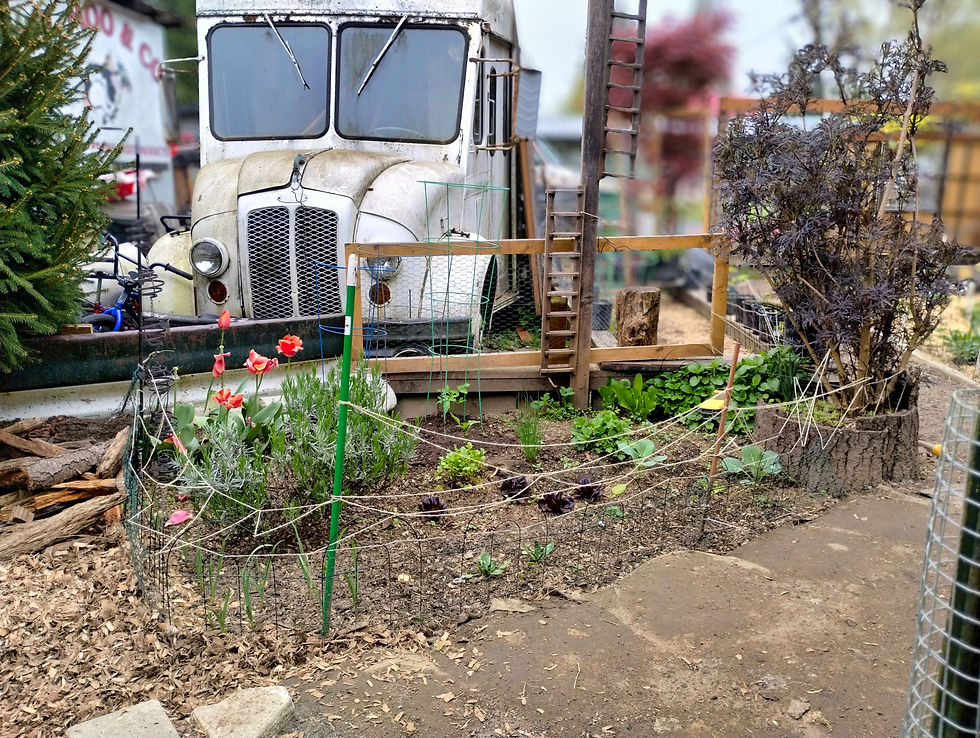
Amid all of this, the garden is beginning to fill in.
This season’s plantings include sea kale, red and white potatoes, tree collards, broccoli, carrots, beets, sugar snap peas, Jerusalem artichokes, garlic, Egyptian walking onions, thyme, cilantro, dill, chives, and lettuce.
Some are just beginning to push through the soil. Others are already settling in. Each one part of the larger system that continues to build year after year.
There’s a steady rhythm returning now — compost turning, seeds sprouting, bees searching, ducks working.
It’s not fast. It’s not perfectly controlled.
But it’s deeply alive.
And for the first time, it truly feels like everything is working together.


Comments